
About
RJ Williams
Public speaker. Founder of Black Ancestry & Reparations and of OUR NATION.
RJ Williams works on one question. Not whether Foundational Black Americans are owed, which he considers settled by the documentary record, but what a repair program would have to look like to actually be built, funded, defended in court and delivered to the right households.
He speaks to churches, campuses, civic organizations and municipal bodies. He founded OUR NATION so the argument would have somewhere to live between talks, and so it would produce something in writing every week instead of dispersing into applause.

Placeholder, replace before launch: RJ Williams portrait
Placeholder, remove before launch
This page deliberately contains no biographical facts we could not verify, and nothing has been invented to fill the gaps. The following still need to come from RJ before launch. Hometown and current base. Professional and educational background. How he came to this work. His own lineage research and what he found. Organizations he is affiliated with. Speaking history, published writing, and podcast or media appearances. A real headshot plus stage photography.
The mission
Honor the contribution. Name the debt. Design the repair.
Start with what was built, not what was suffered
Foundational Black American labor formed the bedrock of the nation’s agricultural economy. Foundational Black Americans have fought in every American war. They originated jazz, blues, gospel, rock and roll, soul and hip hop, which is to say they originated most of what the rest of the world recognizes as American culture. Any conversation that opens with harm and never reaches contribution has already conceded the wrong frame.
Be precise about the sixty years
The period from 1965 to the present is the sharpest part of the argument, because it is the period with the best records and the most living witnesses. The Fair Housing Act did not arrive until 1968. Federal housing capital had already followed the HOLC grades for a generation. The people who were shut out of that are not abstractions, and neither are their grandchildren.
Ask for three things, not one
Direct financial restitution to Foundational Black American families. Large scale investment in education and housing inside those communities. Targeted economic development. A single demand is easy to refuse. A structured program with three components, a funding source and an eligibility rule is a thing legislators have to actually negotiate with.
Make it worth a lawmaker’s while
Moral pressure alone has produced thirty seven years of a bill sitting in committee. Organized constituencies, prepared testimony, model legislation and electoral consequence produce movement. That is unglamorous work, and it is the work.
The ask
Three components, not one demand.
A single demand is easy to refuse. A structured program with three components, a named funding source and a written eligibility rule is something a legislator has to negotiate with rather than dismiss.
This is the position RJ argues from. It is a starting point for the room, not a finished bill, and OUR NATION exists to pressure test it.
See how OUR NATION works-
01
Direct financial restitution
Paid to households, on a documented lineage standard. This is the component with the least public support and the most legal exposure, which is exactly why it has to be the most carefully designed rather than the most loudly demanded.
-
02
Education and housing investment
Directed into the communities the federal government redlined. Educational support polls at 82 percent among people who support repair at all, and home buying support at 73 percent. These are the components that survive a change of administration.
-
03
Targeted economic development
Business capital and community infrastructure. Greenwood mattered because money circulated inside the district before it left. Any program that ignores where the dollars go on day two has evaporated by day thirty.
Our standard
How we handle facts.
This subject attracts inflated numbers from every direction. A single unverifiable figure in a talk hands the room a reason to dismiss everything around it. So we work to a published standard, and you should hold us to it.
- Primary sources first. Statutes, court opinions, agency reports and archived records before news coverage of them.
- Every figure gets a year. Wealth and polling numbers are perishable. A number without a date is a rumor.
- Documented and estimated are different words. Tulsa’s official contemporaneous death tally was 36. The 2001 state commission estimated 100 to 300. We print both and never merge them.
- Announced is not funded. A fundraising target is not money raised. A study commission is not a payment program.
- If we cannot verify it, we leave it out. There are widely circulated per person reparations figures we do not publish, because we could not trace them to a primary source.
- We correct in public. Find an error, send it, and we will fix it and say what changed.
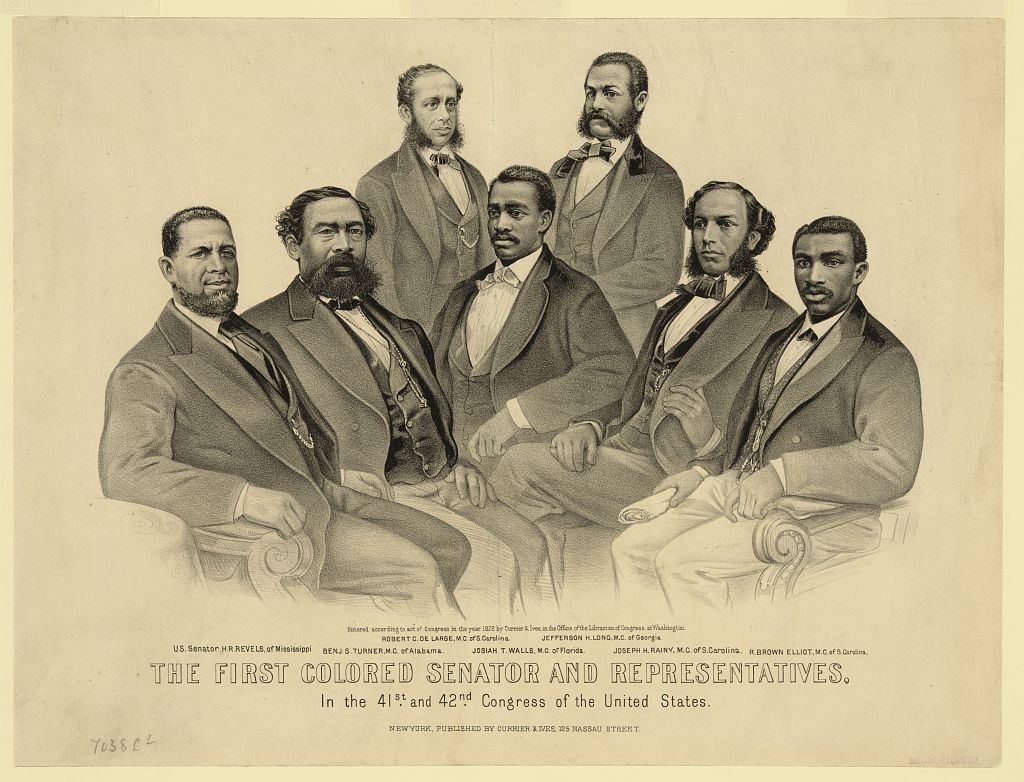
The First Colored Senator and Representatives, 41st and 42nd Congress. Library of Congress. No known restrictions.
Work on this with us.
OUR NATION meets weekly. Membership opens at the Builder tier.